Things You Should and Shouldn’t Do After Bariatric Surgery

Bariatric surgery is a life-changing procedure. Following your doctor’s post-operation instructions and making healthy lifestyle changes are essential to avoiding complications and achieving long-term weight loss success. 

Patients should expect to have a new lifestyle that combines healthy eating, exercise, and attending regular visits with their healthcare providers. They should also consider these dos and don’ts after bariatric surgery: 

  • What you should do after bariatric surgery: 
    • Eat slowly and chew food well 
    • Aim to drink 64oz of fluids daily, taking small sips 
    • Eat 60g or more of protein daily, starting every meal with it 
    • Make fruits and vegetables the priority of your diet 
    • Start walking for five minutes every hour after surgery 
    • Aim for a goal of 30 minutes of exercise daily after it is allowed to do so 
    • Take all medications and supplements as prescribed, they will need to be taken for the rest of your lifetime 
  • What you shouldn’t do after bariatric surgery: 
    • Skip any meals 
    • Eat red meat early in recovery 
    • Engage in any strenuous activities 
    • Lift any objects over 10 lbs. for the first four to six weeks after surgery 
    • Eat fast food 
    • Eat or drink anything with natural sugar 
    • Drink liquids within 30 minutes after eating 
    • Eat bread, rice, pasta, bagels, or dumplings 
    • Allow yourself to get too hungry 
    • Take a bath or go swimming for two weeks after surgery 
    • Smoke cigarettes or drink alcohol 
    • Eat snacks loaded with empty calories 
    • Get pregnant for 12 to 18 months after surgery 
    • Stop taking medications as directed by your healthcare provider 

Bariatric surgery can be a life-changing and life-altering event for those who are trying to lose weight and live a healthier lifestyle. Making diet changes, modifying exercise routine, and following the guidelines set by your healthcare provider and surgical team can lead you to long-term success. 

For more information about the Bariatric Surgery Services at Flushing Hospital or procedures performed by our doctors, please call718-408-6977 or 718-670-8908. 

All content of this newsletter is intended for general information purposes only and is not intended or implied to be a substitute for professional medical advice, diagnosis or treatment. Please consult a medical professional before adopting any of the suggestions on this page. You must never disregard professional medical advice or delay seeking medical treatment based upon any content of this newsletter. PROMPTLY CONSULT YOUR PHYSICIAN OR CALL 911 IF YOU BELIEVE YOU HAVE A MEDICAL EMERGENCY.

Dumping Syndrome

Dumping syndrome or rapid gastric emptying is a condition that occurs when food and gastric juices move abnormally quickly from the stomach to the small intestine after eating.  

Dumping syndrome most commonly occurs after stomach surgery due to it altering the stomach, which can increase the risk of developing the condition. These surgeries are performed mostly to treat obesity, but they can also treat stomach cancer. Dumping syndrome can also happen after esophageal surgery, such as surgery to treat esophageal cancer. Surgeries for other conditions can cause dumping syndrome, including: 

  • Bariatric surgery 
  • Esophagectomy 
  • Gastrectomy 
  • Vagotomy 
  • Fundoplication 
  • Pyloroplasty 

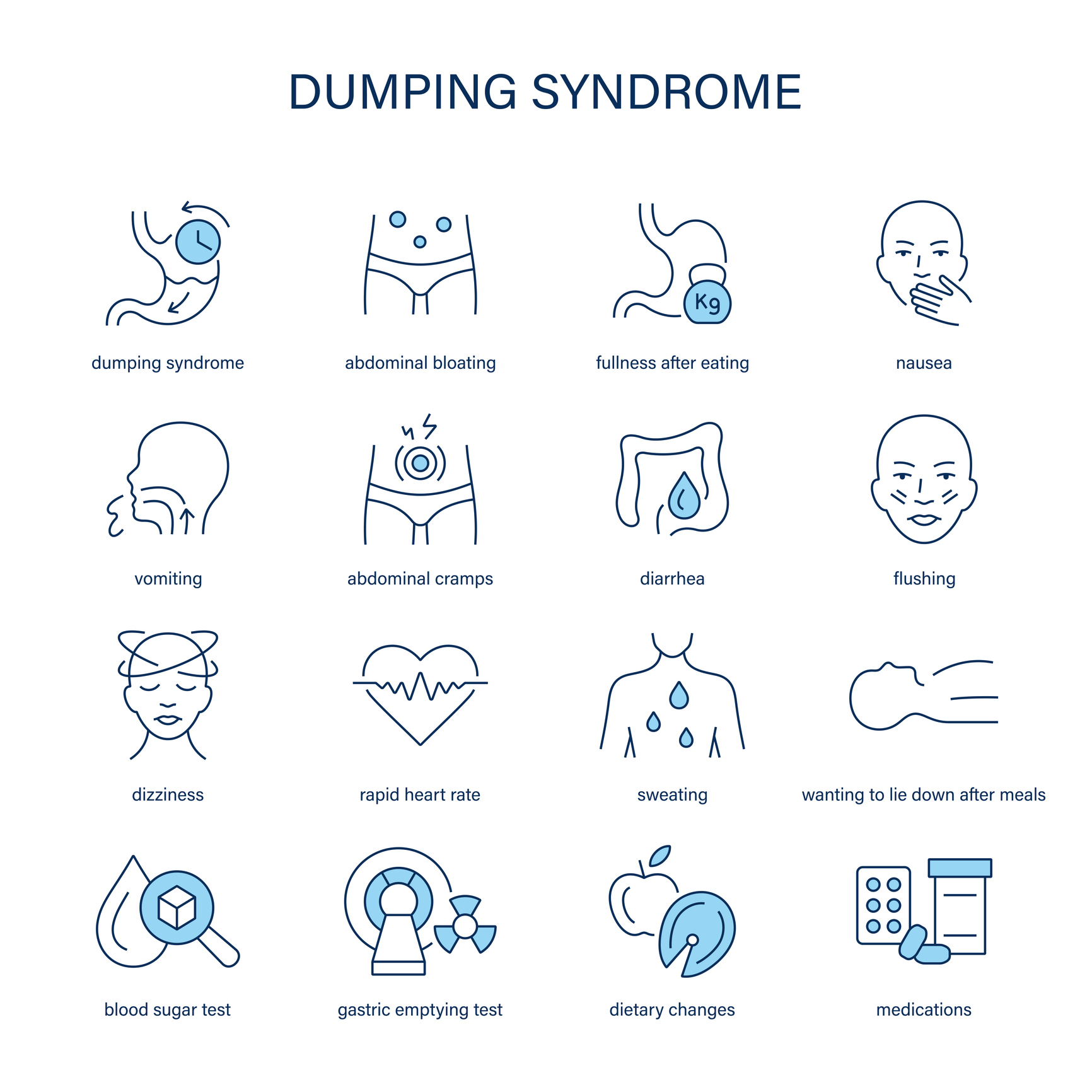
Symptoms of dumping syndrome generally start within minutes after eating, especially meals containing high levels of table sugar and fruit sugar. Symptoms include: 

  • Nausea 
  • Vomiting 
  • Feeling bloated or too full after eating 
  • Stomach cramps 
  • Diarrhea 
  • Rapid heart rate 
  • Dizziness or lightheadedness 
  • Flushing  

Late dumping syndrome starts one to three hours after eating a meal that is high in sugar. It takes time for symptoms to develop because the body releases large amounts of insulin to absorb the sugars entering the small intestine after eating. This process results in low blood sugar levels. Symptoms of late dumping syndrome can include: 

  • Rapid heart rate 
  • Sweating 
  • Weakness  
  • Dizziness or lightheadedness 
  • Flushing 

Some people can have both early and late symptoms. 

A healthcare provider can diagnose dumping syndrome by using the following methods: 

  • Discussing medical history and performing a medical evaluation 
  • Testing blood sugar 
  • Performing a gastric emptying test 

If a person has early dumping syndrome, the condition is likely to resolve itself on its own within three months. In the interim, dietary changes may help ease symptoms. If dietary changes don’t help, an antidiarrheal medicine will be prescribed and injected under the skin to slow food from emptying into the intestine.  

If medication doesn’t work, surgical procedures such as reconstructing the pylorus of a reverse gastric bypass may be recommended. 

There are dietary strategies that can help maintain good nutrition and minimize symptoms, including: 

  • Eating smaller meals 
  • Drinking 6-8 cups of fluids per day 
  • Drinking most of your fluids between meals 
  • Lying down for 30 minutes after meals 
  • Changing your diet 
  • Increasing fiber intake 

If you are going to drink alcohol, it is important to speak with your healthcare provider before doing so. Drinking alcohol beverages can worsen dumping syndrome symptoms because they can be absorbed quickly and can have high sugar content, which can lead to blood sugar levels rising rapidly and cause a significant insulin spike and then eventually low blood sugar. 

If you or a loved one is experiencing symptoms associated with dumping syndrome, you can receive treatment at Flushing Hospital Medical Center’s Ambulatory Care Center. To schedule an appointment, please call (718) 670-5486. 

All content of this newsletter is intended for general information purposes only and is not intended or implied to be a substitute for professional medical advice, diagnosis or treatment. Please consult a medical professional before adopting any of the suggestions on this page. You must never disregard professional medical advice or delay seeking medical treatment based upon any content of this newsletter. PROMPTLY CONSULT YOUR PHYSICIAN OR CALL 911 IF YOU BELIEVE YOU HAVE A MEDICAL EMERGENCY.

How to Set Healthy Weight Loss Goals

Embarking on a weight loss journey can be a difficult and sometimes daunting experience. There are many factors that can affect a person’s weight management, such as medical conditions, certain medicines, stress, age, genes, hormones, and environment.  

However, maintaining a lifestyle that consists of a good nutritional diet, regular physical activity, stress management, and proper sleep can support a healthy weight. Additionally, people who lose weight gradually, which is about one to two pounds a week, are more likely to keep the weight off than those who lose weight more quickly.  

If a person is not at a healthy weight, moderate weight loss can help improve their cholesterol, blood pressure, and blood sugar levels. Just a 5% to 10% reduction of their current weight may lower their risk for some chronic diseases, such as heart disease, prediabetes, and type 2 diabetes. Other benefits of moderate weight loss include: 

  • More energy  
  • Better mobility  
  • A boost in self-confidence 
  • Improved fitness 

Starting a weight loss journey can be challenging. However, having and following a plan can help make the journey easier. Here are five steps that can help guide you to a healthier weight: 

  • Consider the reasons why you want to lose weight. Writing down your reasons and posting them where you can see them can help remind you why you are making this change and keep you focused on your weight loss goals 
  • Keep track of where you are as you begin your weight loss journey. You can keep a journal of your nutrition to help you keep track of what you eat and drink in a day. Make note of your physical activity by including the time of day you exercised, what activities you did, and for how long. Maintain a chart of your sleep schedule, including what time you went to sleep and woke up, and the number of hours you slept. Monitor your stress levels and the healthy ways you are reducing your stress. You can also track how you felt during your meals, when you exercise, and any lifestyle challenges that have affected your progress 
  • Set specific and realistic goals. Creating short-term goals with rewards can help prevent you from feeling frustrated when there is a setback. When setting short-term goals, focus on two or three goals at a time 
  • Find a good support system. Surround yourself with family or friends who are supportive of your weight loss goals. If they have similar goals, they may share resources that have helped them on their weight loss journey 
  • Stay up to date with your progress throughout your weight loss journey. Regularly evaluate your progress by revisiting the goals you set. Determine what has been working well and what hasn’t been, and use this information to make any changes to your goals and weight loss plan. If you are consistently meeting a particular goal, you can reward yourself for achieving your goals. It is important to recognize and be proud of your progress as you meet your goals. Rewarding yourself helps to keep you motivated and on the right path 

Please note that before you start your weight loss journey, speak with your healthcare provider so you can decide whether or not it’s a good time to set a weight loss goal. 

And if you do go on a weight loss journey, don’t get discouraged if you aren’t losing weight as quickly as you had hoped. Remember that sustainable weight loss takes time.  

For more information about the Bariatric Surgery Services at Flushing Hospital or procedures performed by our doctors, please call718-408-6977 or 718-670-8908. 


All content of this newsletter is intended for general information purposes only and is not intended or implied to be a substitute for professional medical advice, diagnosis or treatment. Please consult a medical professional before adopting any of the suggestions on this page. You must never disregard professional medical advice or delay seeking medical treatment based upon any content of this newsletter. PROMPTLY CONSULT YOUR PHYSICIAN OR CALL 911 IF YOU BELIEVE YOU HAVE A MEDICAL EMERGENCY.
Holiday Eating Tips After Bariatric Surgery

It’s the holiday season, and as we spend time with our family and friends, we enjoy each other’s company over delicious meals. Unfortunately, the holiday season can be a time when we run into problems with weight gain. It can be especially challenging after bariatric surgery. Fortunately, there are many ways to manage our weight during the holiday season. Here are 10: 

  1. Don’t save your calories. It may be tempting to skip meals to save calories for holiday treats, but it is better to stick to your regular eating patterns. You are more likely to overeat if you arrive at a holiday function hungry 
  1. Remember the basics. Just because it is the holidays doesn’t mean you can’t maintain the same healthy eating habits you had during the rest of the year. Pay attention to your portion sizes, start with protein, eat slowly, and track what you eat. Keeping these basic rules in mind can help you avoid overeating 
  1. Be mindful of how much you are eating. Eating while socializing can easily lead to eating too much. Enjoy the company and conversation and save eating for a time when you can focus on your meal 
  1. Avoid the buffet table and the kitchen. Standing close to where the food is being served may result in mindless noshing. Carefully select the food you truly want to try, and then walk away 
  1. Limit alcohol consumption. Drinks containing alcohol are full of empty calories. It is better to eat your calories than to drink them. Additionally, alcohol doesn’t just add calories; it can also dehydrate you. Be aware that alcohol can affect you differently after bariatric surgery. You may feel the effects much sooner, even after consuming less alcohol. You are also more likely to overeat at the buffet table after a couple of drinks 
  1. Stay hydrated. It is important to drink plenty of water and plan ahead. This ensures that you can avoid drinking within 30 minutes of eating and still get in the recommended 64 ounces a day 
  1. Exercise. The holiday season can be a busy time, and our exercise routines may suffer because of it. It is easier to get out of the habit of exercising than it is to get back into it after the holidays. Consider creating a workout schedule or organizing activities for the family that get everyone moving 
  1. Bring a healthy dish to share. This will ensure that there is a healthy food option at the gathering 
  1. Find healthy alternatives for your favorite recipes. Look for healthier substitutions that cut the fat and calories of recipes. Some examples include: 
  • Using skim milk instead of whole milk in mashed potatoes 
  • Using fat-free creamed soups in recipes rather than full-fat versions 
  • Replacing sugar with unsweetened apple sauce or noncaloric sweeteners in desserts 
  • Adding flavor with garlic, spices, and herbs rather than fats such as butter and gravy 
  • Combining ¼ cup of Greek yogurt with ½ cup of butter to replace 1 cup of butter in a recipe 
  • Replacing each egg with two egg whites and substitute evaporated skim milk in place of heavy cream when baking your favorite holiday treats 
  1. Be kind to yourself. You may overeat a bit or sample more treats than you should. However, that doesn’t mean all is lost. It is important to forgive yourself and recommit to healthy patterns and move forward. It is okay to have a treat once in a while. 

Undergoing bariatric surgery requires preparation, dedication, and several lifestyle adjustments. Adopting a whole different way of eating can be challenging, and it will take some time to get used to it. Following these tips can help you plan and enjoy your food in moderation. 

For more information about the Bariatric Surgery Services at Flushing Hospital or procedures performed by our doctors, please call718-408-6977 or 718-670-8908. 


All content of this newsletter is intended for general information purposes only and is not intended or implied to be a substitute for professional medical advice, diagnosis or treatment. Please consult a medical professional before adopting any of the suggestions on this page. You must never disregard professional medical advice or delay seeking medical treatment based upon any content of this newsletter. PROMPTLY CONSULT YOUR PHYSICIAN OR CALL 911 IF YOU BELIEVE YOU HAVE A MEDICAL EMERGENCY.

Common Misconceptions About Bariatric Surgery

Bariatric, or gastric bypass surgery for weight loss, is a surgical treatment for severe obesity that involves making changes to the digestive system. It is performed when diet and exercise haven’t worked, or when a person is at risk for serious health problems due to their weight.

There are several myths and misconceptions about bariatric surgery and its outcomes, including:

  • Bariatric surgery is unnecessary, and people just need to eat less and exercise more
  • Bariatric surgery is dangerous
  • Bariatric surgery will make a person thin
  • Bariatric surgery and weight loss will make a person happy and improve their relationships
  • Bariatric surgery will prevent a person from overeating
  • Bariatric surgery is an easy way out
  • Most people will gain the weight back after surgery

Bariatric surgery can be a lifesaving solution for many people who are overweight. Bariatric surgery, along with a commitment to lifestyle changes, not only provides long-term weight loss but it significantly improves the health and quality of life for many.

For more information about the Bariatric Surgery Services at Flushing Hospital or procedures performed by our doctors, please call 718-408-6977 or 718-670-8908.


All content of this newsletter is intended for general information purposes only and is not intended or implied to be a substitute for professional medical advice, diagnosis or treatment. Please consult a medical professional before adopting any of the suggestions on this page. You must never disregard professional medical advice or delay seeking medical treatment based upon any content of this newsletter. PROMPTLY CONSULT YOUR PHYSICIAN OR CALL 911 IF YOU BELIEVE YOU HAVE A MEDICAL EMERGENCY.

What to Know About Protein Intake While on Weight Loss Medication

GLP-1 antagonists are a class of medications that mainly manage blood sugar levels in people with Type 2 diabetes. Some GLP-1 antagonists can also help treat obesity.

When a person starts to lose weight on a GLP-1 weight loss medication, it can happen very fast. However, as they lose fat, they could also be losing essential lean muscle mass, which can harm their metabolism and blood sugar levels. This will ultimately work against weight loss efforts and can even negatively affect bone health.

Protein is the building block of muscle. Getting enough is crucial for preventing muscle loss, especially when consuming fewer calories. When you consume enough protein, you are more likely to retain and even build muscle. However, when you don’t have enough protein, your body will cannibalize some of your muscle mass for energy.

A 2024 review study that made diet recommendations for GLP-1 patients based on the latest research recommends at least 60 grams of protein a day. It is suggested to aim for 20 to 40 grams of protein at every meal.

Most people who are on GLP-1 medications experience at least one side effect. The side effects are worse just after starting and in the days after increasing the dose. Fortunately, there are ways to combat those side effects, including:

  • Make every meal count
  • Schedule your meals
  • Make protein a priority
  • Aim for 64 ounces of fluid a day, plus electrolytes
  • Avoid fatty and greasy foods
  • Steer clear of sugary foods, alcohol, and refined carbs
  • Maintain muscle with resistance training
  • Eat smaller portions more frequently
  • Add fiber to your diet
  • Talk to your doctor if you are having side effects

For more information about the Bariatric Surgery Services at Flushing Hospital or procedures performed by our doctors, please call 718-408-6977 or 718-670-8908.


All content of this newsletter is intended for general information purposes only and is not intended or implied to be a substitute for professional medical advice, diagnosis or treatment. Please consult a medical professional before adopting any of the suggestions on this page. You must never disregard professional medical advice or delay seeking medical treatment based upon any content of this newsletter. PROMPTLY CONSULT YOUR PHYSICIAN OR CALL 911 IF YOU BELIEVE YOU HAVE A MEDICAL EMERGENCY.

Bariatric Surgery- What is Revision Surgery?

Bariatric or gastric bypass surgery involves making changes to the digestive system to help lose weight. It is done when diet and exercise haven’t worked or when you are at risk of serious health problems due to your weight.

Bariatric revision surgery is a broad term used to describe follow-up procedures required for all patients who previously had weight-loss surgery. These procedures are intended to make a patient’s initial weight-loss procedure more effective, to minimize unpleasant side effects, or to reverse the original surgery.

A patient may be a candidate for bariatric revision surgery for one or more of the following reasons:

  • Insufficient weight loss
  • Complications
  • Side effects
  • Weight regain
  • Malnutrition

Surgeons can revise an initial bariatric surgery in several ways, depending on the problems that stem from the initial surgery. The surgeons then repair, convert, or reverse that procedure.

The bariatric revision surgical procedure options that are used for the three most common types of bariatric surgery include:

  • Sleeve gastronomy
  • Gastric bypass surgery
  • Gastric band surgery

Bariatric revision surgery is performed to improve a patient’s health or quality of life. The procedure may encourage greater weight loss in patients whose previous surgeries didn’t lead to the expected loss of excess body weight. It may also address complications from the prior bariatric procedure, such as an ulcer or stricture, and reduce or eliminate unwanted side effects, such as swallowing difficulties or GERD.

For more information about the Bariatric Surgery Services at Flushing Hospital or procedures performed by our doctors, please call 718-408-6977 or 718-670-8908.


All content of this newsletter is intended for general information purposes only and is not intended or implied to be a substitute for professional medical advice, diagnosis or treatment. Please consult a medical professional before adopting any of the suggestions on this page. You must never disregard professional medical advice or delay seeking medical treatment based upon any content of this newsletter. PROMPTLY CONSULT YOUR PHYSICIAN OR CALL 911 IF YOU BELIEVE YOU HAVE A MEDICAL EMERGENCY.

Robotics: Gastric Bypass

Gastric bypass or “Roux-en-Y” is a metabolic and weight-loss procedure that works by modifying your digestive system so that you consume and absorb fewer calories. It modifies your stomach and also your small intestines.

Similar to other bariatric surgery operations, gastric bypass is recommended for people who have clinically severe obesity. It has been shown to help relieve a long list of obesity-related health conditions, including:

  • Type 2 diabetes
  • Hypertension
  • Obstructive sleep apnea
  • GERD (chronic acid reflux)
  • Heart disease
  • Hyperglycemia
  • Fatty liver disease
  • Hyperlipidemia
  • Osteoarthrosis

The Roux-en-Y procedure gets its name from how it changes your digestive system. “Roux-en-Y” means “in the shape of a Y”. The procedure divides your stomach and small intestine, connecting each new segment to form a “Y” shape. This procedure reduces the functional part of your stomach to a small pouch, separating it from the rest with surgical staples, and restricting the amount of food your stomach can hold. Then, it connects the new stomach pouch to a lower segment of your small intestine. This means that when food goes through your digestive system, it will now bypass most of your stomach and the first part of your small intestine, causing your digestive system to not absorb all of the nutrients or calories in your food.

Gastric bypass surgery requirements are similar to those of other bariatric procedures. A qualified healthcare provider must recommend you for surgery. You may be a candidate for gastric bypass surgery if you:

  • Have been diagnosed with class III obesity
  • Have a BMI of at least 35 with at least one obesity-related condition
  • Have obesity-related type 2 diabetes

Most Roux-en-Y surgical procedures today are laparoscopic, a minimally invasive surgical technique. However, sometimes they are done with robotic assistance.

There are many potential advantages of robotic-assisted surgery over other types of surgery including:

  • Robot-assisted surgery provides the surgeon with 3D images of inside your abdomen that create a clearer picture for them to reference as they operate compared to the 2D images used during laparoscopic surgery
  • Under the surgeon’s direction, the robot can move more freely and with more versatility than a human hand
  • You’ll have a few tiny scars rather than one large incision scar (as with open surgery)
  • You’re more likely to experience less pain and less bleeding after surgery compared to open surgery
  • You’re more likely to have a quicker recovery time than with open surgery

To learn more about the robotic surgical procedures at Flushing Hospital Medical Center or to schedule an appointment, call (718) 670-5000.


All content of this newsletter is intended for general information purposes only and is not intended or implied to be a substitute for professional medical advice, diagnosis or treatment. Please consult a medical professional before adopting any of the suggestions on this page. You must never disregard professional medical advice or delay seeking medical treatment based upon any content of this newsletter. PROMPTLY CONSULT YOUR PHYSICIAN OR CALL 911 IF YOU BELIEVE YOU HAVE A MEDICAL EMERGENCY.

Do Genetics Affect Obesity?

Most people become obese when they habitually consume more calories than the amount needed to maintain their regular bodily functions. However, obesity may occur in some people more easily than in others, partially as a result of their genes.

More than 50 genes are associated with obesity. These genes typically affect the brain signals and subsequent hormonal responses associated with food intake; for example, the fat mass- and obesity-associated gene (FTO) gene promotes food intake.

Most people do not have a single identifiable genetic cause for their obesity, but rarely, monogenic (single-gene) obesity may occur due to inherited changes in specific genes. This most commonly occurs due to the changes in the gene MC4R, which stimulates appetite.  These changes may lead to extreme hunger and increase the risk of developing conditions such as hyperphagia (excessive eating).

Generally, individual genes only lead to small effects on a person’s likelihood of becoming obese. In most cases, obesity is actually the result of many genes and environmental factors interacting with one another.

For many people with an increased genetic likelihood of becoming obese, standard methods of managing weight, such as regular physical exercise and a balanced diet, can be effective. However, other people with these genes may only see minimal results from these methods. In these cases, a medical intervention such as bariatric surgery may be the best path forward.

Bariatric surgery is typically reserved for:

  • People with a body mass index (BMI) of 40 or higher
  • People with a BMI of 35 or higher who have a serious weight-related condition such as type 2 diabetes or high blood pressure

You can schedule an appointment at Flushing Hospital Medical Center’s Bariatric Surgery Center to determine whether this type of procedure is right for you by calling (718) 670-8908 or (718) 408-6977.

All content of this newsletter is intended for general information purposes only and is not intended or implied to be a substitute for professional medical advice, diagnosis or treatment. Please consult a medical professional before adopting any of the suggestions on this page. You must never disregard professional medical advice or delay seeking medical treatment based upon any content of this newsletter. PROMPTLY CONSULT YOUR PHYSICIAN OR CALL 911 IF YOU BELIEVE YOU HAVE A MEDICAL EMERGENCY.

What Can You Eat After Bariatric Surgery?

After undergoing certain types of bariatric procedures, such as a sleeve gastrectomy or gastric bypass surgery, you won’t be able to go back to eating solid foods right away. Your stomach needs time to recover, and you will need to ease yourself into a new, healthy diet. For this reason, most patients spend the first several weeks after surgery gradually transitioning from a liquid diet to pureed foods, soft foods, and eventually certain solid foods.

Generally, the transition back to solid foods can take approximately eight weeks. The timeline of this period generally occurs as follows:

Week One: During your first week after surgery, you’ll typically only be able to consume a clear liquid diet, which includes:

  • Water
  • Coffee or tea (without milk or creamer)
  • Non-fat broth
  • Fruit and vegetable juices without pulp
  • Soda
  • Sports drinks
  • Clear nutritional drinks
  • Jello

Week Two: If you’ve successfully tolerated liquids throughout your first week, you may begin to re-introduce foods that can be pureed, such as scrambled eggs, cream soups, or proteins such as lean ground beef, poultry, or fish. Each meal should only consist of up to six tablespoons of food and be eaten slowly.

After a few weeks, with your doctor’s approval, you may begin to re-introduce soft foods such as ground meat or poultry, rice, and cooked skinless vegetables. These meals should generally consist of no more than half a cup of food.

Week Eight: After about eight weeks of following this diet, you can start to re-introduce a limited number of solid foods into your diet. You should only try one of these foods at a time and anticipate potential issues such as pain, nausea, or vomiting. Limit your daily eating to three meals of approximately one and a half cups of food.

To receive more information about bariatric surgery and schedule a consultation, you can call Flushing Hospital Medical Center’s Comprehensive Bariatric Surgery Center by calling (718) 670-8909.

All content of this newsletter is intended for general information purposes only and is not intended or implied to be a substitute for professional medical advice, diagnosis or treatment. Please consult a medical professional before adopting any of the suggestions on this page. You must never disregard professional medical advice or delay seeking medical treatment based upon any content of this newsletter. PROMPTLY CONSULT YOUR PHYSICIAN OR CALL 911 IF YOU BELIEVE YOU HAVE A MEDICAL EMERGENCY.