Top 5 Women’s Health Issues

Do you know which health conditions pose the biggest threat to American women? The good news is that many of the leading threats to women’s health, which can vary based on a woman’s age and background, are preventable. Find out which conditions to be aware of to maximize your health today.

  1. Heart disease is the leading cause of death among women. Luckily, there are many lifestyle changes you can make to ward off heart disease, such as not smoking, following a heart-smart diet, and being physically active.


  1. Stroke poses a significant risk to women’s health in the United States. Almost 55,000 women suffer from stroke each year, and about 60 percent of overall stroke deaths occur among women.


  1. Two of the most common cancers affecting women are breast and cervical cancers. Early detection is the key to keeping women alive and healthy. The most recent figures show that around half a million women die from cervical cancer and half a million from breast cancer each year.


  1. Sexually transmitted diseases are responsible for one third of health issues for women between the ages of 15 and 44 years. Unsafe sex is a major risk factor – particularly among women and girls in developing countries.


  1. Depression is the most common mental health problem for women and suicide a leading cause of death for women under 60. Evidence suggests that women are more prone than men to experience anxiety, depression, and somatic complaints – physical symptoms that cannot be explained medically.


The first step to staying healthy is educating yourself, and then taking the necessary precautions to reduce your risk. While you can’t eliminate risk factors such as family history, you can control many other risk factors for heart disease, stroke and cancer. Also be sure to consult your doctor about when you should have mammograms and other cancer screenings. The Outpatient Mental Health Division at Flushing Hospital Medical Center has an experienced and friendly staff readily available to assist you. To make an appointment please call, 718-670-5562. If you are experiencing stroke or heart disease symptoms please refer to the Ambulatory Care Center at Flushing Hospital. To make an appointment, please call 718-670-5486.

All content of this newsletter is intended for general information purposes only and is not intended or implied to be a substitute for professional medical advice, diagnosis or treatment. Please consult a medical professional before adopting any of the suggestions on this page. You must never disregard professional medical advice or delay seeking medical treatment based upon any content of this newsletter. PROMPTLY CONSULT YOUR PHYSICIAN OR CALL 911 IF YOU BELIEVE YOU HAVE A MEDICAL EMERGENCY.
Signs of a Stroke

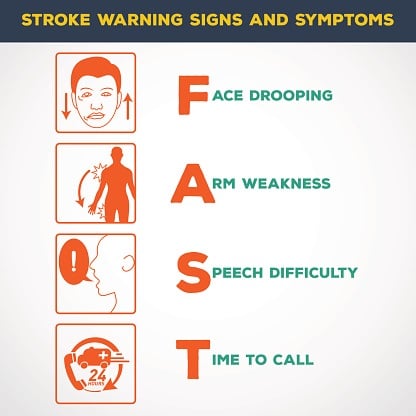
stroke and symptoms V2 -493247760The easiest way to recognize the warning signs of a stroke is to think F.A.S.T.  If someone you know is suddenly exhibiting the following signs, call 9-1-1 for help immediately:

F- Face Drooping: If one side of the person’s face is drooping, ask them if their face feels numb and ask them to smile.   You should be concerned if they are unable to smile or their smile is uneven.

A- Arm weakness:  Does the individual’s arm feel numb or weak? Ask them to raise both arms and watch to see if one arm drifts downward.

S- Speech difficulty: If the person is trying to speak and they are difficult to understand or their speech is slurred, ask them to say a simple sentence, such as “my name is Jane,” repeatedly.

T- Time to call 9-1-1:  You should never wait more than five minutes to call 9-1-1 if someone is displaying these warning signs.

Additional symptoms of a stroke are:

  • Sudden confusion
  • Severe headaches
  • Blurred vision
  • Dizziness
  • Sudden loss of coordination

Stroke is one of the leading causes of death and long-term disability in the United States.  Eighty percent of strokes are preventable and by spotting these warning signs and acting quickly, the severity of a stroke can be reduced drastically.   during the month of May we are showing our support for stroke awareness and American Stroke Month through education.   To speak with a medical professional about stroke prevention and care please call our ambulatory care unit at

During the month of May, Flushing Hospital  is  showing its support for stroke awareness and American Stroke Month by providing education to the communities it serves.   To speak with a medical professional about stroke prevention and care please call our ambulatory care unit at 718-670-5486 or visit the National Stroke Association’s website at www.stroke.org.

All content of this newsletter is intended for general information purposes only and is not intended or implied to be a substitute for professional medical advice, diagnosis or treatment. Please consult a medical professional before adopting any of the suggestions on this page. You must never disregard professional medical advice or delay seeking medical treatment based upon any content of this newsletter. PROMPTLY CONSULT YOUR PHYSICIAN OR CALL 911 IF YOU BELIEVE YOU HAVE A MEDICAL EMERGENCY.