
Strep vs. Sore Throat

We all develop a sore throat from time to time. There are many reasons for this. It might be due to a viral infection, an allergic reaction, or hoarseness from overuse.  In some cases, however, a sore throat can be a symptom of strep throat, which is a bacteria that if left untreated can lead to serious complications.

Strep throat is an infection of the throat and tonsils. You can get the infection from someone who is sick with it or is a carrier of it. Like other infections, it spreads from person to person or by touching objects that are contaminated and then touching your own eyes, mouth or nose. Strep throat is most common in children, but anyone can get it.

In addition to a sore throat some other symptoms of strep throat include:

  • A fever of 101 F or higher
  • Red, swollen tonsils
  • White patches in the throat
  • Tiny red spots on the roof of the mouth
  • Appetite loss
  • Headache
  • Stomach pain, nausea, or vomiting
  • Rash

Your doctor will ask about your symptoms and can administer a test to confirm if you have strep. There are two ways to test:

  • A rapid strep test can identify a case in just a few minutes. The doctor will gently hold down your tongue with a depressor. Then, use a cotton swab to take a little bit of mucous from the back of the throat.
  • A throat culture is performed by rubbing the sample from the throat swab onto a special dish. If you have strep throat, the streptococci bacteria will grow in it. It usually takes about two days to get results from a throat culture.

If you have strep, your doctor will prescribe antibiotics to kill the bacteria that caused the infection. Most treatments last for about ten days. The medicine can make your symptoms go away faster and help prevent complications. It is important to take the full the dose of antibiotics. Stopping the medicine too early can leave some bacteria alive, which can make you sick again.

Other things you can take to treat the symptoms of strep throat include:

  • Ibuprofen or acetaminophen to bring down a fever and ease pain.
  • Throat lozenges or piece of hard candy to soothe a sore throat.
  • Liquids such as tea and broth or something cold such as an ice pop.

The best way to prevent getting strep is to practice good hygiene. Don’t share cups, dishes, forks, or other personal items with someone who’s sick and wash your hands or use an alcohol-based hand sanitizer many times daily.

If untreated, strep can lead to scarlet fever, inflammation of the kidney, and rheumatic fever; a serious inflammatory condition that can affect the heart, joints, nervous system and skin.

Make an appointment with your doctor if you suspect that you or your child has strep throat. If you do not have a doctor, please call Flushing Hospital Medical Center’s Ambulatory Care Center at 718-670-5486 to schedule an appointment.

All content of this newsletter is intended for general information purposes only and is not intended or implied to be a substitute for professional medical advice, diagnosis or treatment. Please consult a medical professional before adopting any of the suggestions on this page. You must never disregard professional medical advice or delay seeking medical treatment based upon any content of this newsletter. PROMPTLY CONSULT YOUR PHYSICIAN OR CALL 911 IF YOU BELIEVE YOU HAVE A MEDICAL EMERGENCY.

Multiple Sclerosis Education and Awareness Month

March is Multiple Sclerosis (MS) Education and Awareness Month. In an effort to raise awareness to this disease, Flushing Hospital Medical Center would like to share the following facts about MS.

Multiple Sclerosis is an auto-immune disease that effects the body’s muscles and spinal cord. According to the National Multiple Sclerosis Society, the cause of MS is still unknown. Scientists believe that a combination of environmental and genetic factors contribute to the risk of developing MS.

The progress, severity and specific symptoms of MS in any one person cannot yet be predicted. Most people with MS are diagnosed between the ages of 20 and 50, with at least two to three times more women than men being diagnosed with the disease.

Some symptoms of MS are:

  • vision problems.
  • numbness and tingling.
  • muscle spasms, stiffness and weakness.
  • mobility problems.
  • problems with thinking, learning and planning.
  • depression and anxiety.

Treatment for MS varies depending on the degree of severity.  Some more widely used treatments are oral medications, medical infusions, muscle relaxants and physical therapy.

Often times, a complete neurological exam and medical history are needed to diagnose MS . There is not a specific test that diagnoses MS, instead, a diagnosis of MS may rely on ruling out other conditions that might produce similar signs and symptoms, this is known as a differential diagnosis.

If you are experiencing some of the signs and symptoms of Multiple Sclerosis and would like to see a doctor, you can call Flushing Hospital Medical Center’s Ambulatory Care Center at 718-670-5486 to schedule an appointment.

If you’d like to find out more about Multiple Sclerosis, you can visit: https://www.mayoclinic.org/diseases-conditions/multiple-sclerosis/symptoms-causes/syc-20350269  and nationalmssociety.org


All content of this newsletter is intended for general information purposes only and is not intended or implied to be a substitute for professional medical advice, diagnosis or treatment. Please consult a medical professional before adopting any of the suggestions on this page. You must never disregard professional medical advice or delay seeking medical treatment based upon any content of this newsletter. PROMPTLY CONSULT YOUR PHYSICIAN OR CALL 911 IF YOU BELIEVE YOU HAVE A MEDICAL EMERGENCY.
#WorkoutWednesday – Exercises That Work The Entire Body

It is recommended by the U.S. Department of Health that adults get 75 to 150 minutes of exercise each week; however, many do not have the luxury of time to work out frequently and some are confined to the office for eight hours or more each day.   Despite the limitations of a busy schedule, there are ways to fit exercise into your daily routine. Keep in mind that some exercise is better than none and that squeezing in a few minutes each day can be beneficial to your health.

Practical steps you can take in fitting daily exercise are to:

  • Wake up fifteen minutes earlier each day to work out.
  • Take 10 to 15 minutes away from time spent on the internet, connecting on social media or texting.
  • Work out while watching TV- you can simply jog or run in place.
  • Take the stairs at work instead of the elevator.
  • Sit up straight at your desk then contract and release your stomach muscles. This will give you a quick abdominal work out.
  • You can work your legs muscles by squeezing your thighs together or extending each leg in front of you for a few seconds on each side.
  • Go for a walk during your lunch break
  • Have fun. Dance to your favorite songs or play a fitness video game.

Exercise is essential to your health. Although your schedule may be hectic, try to find the time for a few minutes of physical activity into your daily routine.

All content of this newsletter is intended for general information purposes only and is not intended or implied to be a substitute for professional medical advice, diagnosis or treatment. Please consult a medical professional before adopting any of the suggestions on this page. You must never disregard professional medical advice or delay seeking medical treatment based upon any content of this newsletter. PROMPTLY CONSULT YOUR PHYSICIAN OR CALL 911 IF YOU BELIEVE YOU HAVE A MEDICAL EMERGENCY.

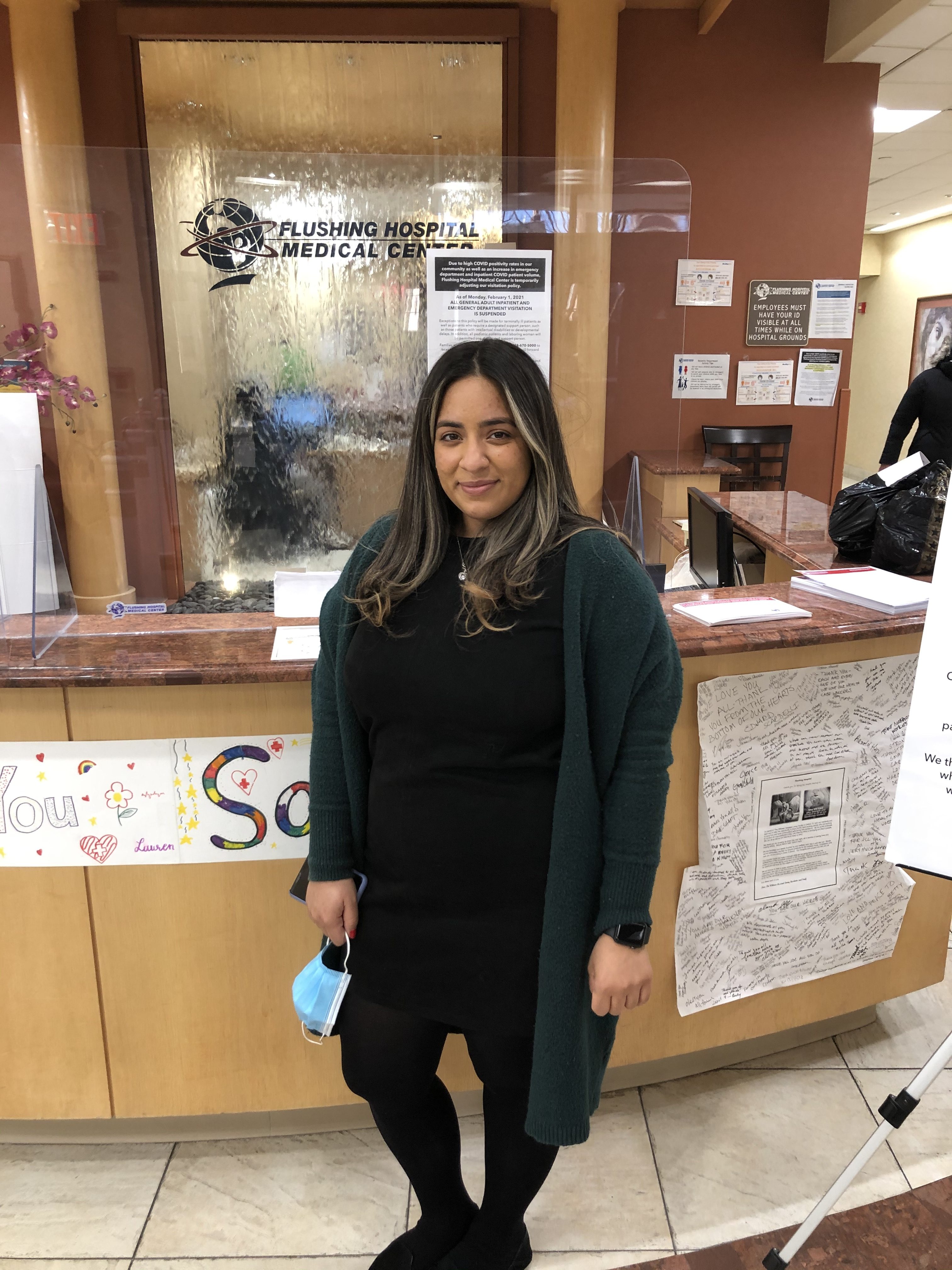
Employee Spotlight – Gabrielle Medina

Flushing Hospital Medical Center’s February Employee Spotlight shines on Patient Navigator, Gabrielle Medina.  Ms. Medina is being recognized for her tireless efforts to register fellow employees to receive the COVID-19 vaccine.  Gabrielle Medina registered more than 1000 hospital employees and their eligible family members. Her efforts did not go unnoticed by our hospital administrators and her colleagues. Throughout the entire time, she remained calm, courteous and professional.  For these and so many other reasons, Gabrielle Medina is our February Employee Spotlight.

All content of this newsletter is intended for general information purposes only and is not intended or implied to be a substitute for professional medical advice, diagnosis or treatment. Please consult a medical professional before adopting any of the suggestions on this page. You must never disregard professional medical advice or delay seeking medical treatment based upon any content of this newsletter. PROMPTLY CONSULT YOUR PHYSICIAN OR CALL 911 IF YOU BELIEVE YOU HAVE A MEDICAL EMERGENCY.

How Long Can I Wear The Same Mask?

Nowadays, one of the more frequently asked questions is, “How long can I wear the same mask?”

The answer to that question varies depending on the type of mask you are wearing.

According to the Centers for Disease Control and Prevention (CDC) the best practices for cleansing the more commonly used masks are as follows:

  • Cloth cotton – Wash you cloth mask whenever it gets dirty or at least daily in warm soapy water or in your washing machine.
  • Non-medical disposable – Single use masks should be thrown away after one wearing.
  • Face shields and goggles – Clean and disinfect reusable face shields according to the manufacturer’s instructions.  If disposable, wear it once and discard it according to the manufacturer’s instructions.

To learn more about these and other types of masks and how to care for them, visit:

https://www.cdc.gov/coronavirus/2019-ncov/prevent-getting-sick/how-to-wash-cloth-face-coverings.html

All content of this newsletter is intended for general information purposes only and is not intended or implied to be a substitute for professional medical advice, diagnosis or treatment. Please consult a medical professional before adopting any of the suggestions on this page. You must never disregard professional medical advice or delay seeking medical treatment based upon any content of this newsletter. PROMPTLY CONSULT YOUR PHYSICIAN OR CALL 911 IF YOU BELIEVE YOU HAVE A MEDICAL EMERGENCY.

Employee Spotlight – Anthony Di Preta

January’s Flushing Hospital Medical Center’s (FHMC) Employee Spotlight shines Security Officer Anthony Di Preta. Anthony has been a security officer for the past 12 years and is tasked with securing the hospital premises, directing visitor traffic, observing and reporting suspicious activity, checking for property damage, monitoring the hospitals closed circuit TV (CCTV), and checking that the proper hospital identification is being displayed on each employee.

When not at work, Anthony enjoys watching movies, playing pool and fixing model cars.  He is active in his local chapter of the Knights of Columbus.

“The most rewarding part of my job is making people happy and helping people.  The most challenging part of my job is diffusing possible volatile situations.

Congratulations Anthony Di Preta on being featured on FHMC’S Employee Spotlight!


All content of this newsletter is intended for general information purposes only and is not intended or implied to be a substitute for professional medical advice, diagnosis or treatment. Please consult a medical professional before adopting any of the suggestions on this page. You must never disregard professional medical advice or delay seeking medical treatment based upon any content of this newsletter. PROMPTLY CONSULT YOUR PHYSICIAN OR CALL 911 IF YOU BELIEVE YOU HAVE A MEDICAL EMERGENCY.

National Healthy Weight Week

The third week in January is designated as National Healthy Weight Week. In an effort to promote a healthy nutritional lifestyle, Flushing Hospital Medical Center would like to offer the following tips to help you achieve and maintain a healthy weight.

  • Set a Goal – You can’t set out on a mission to lose weight without knowing how you are going to do it. Create a detailed weight-loss plan and set a goal that is specific, measurable and realistic.
  • Be Patient – In most cases if you make modest adjustments in your lifestyle, you can lose the weight gradually, but steadily. Dietary changes are typically easier to follow when you take slow, small steps.
  • Drink Plenty of Water – Water is free of calories, inexpensive and provides your body with a quenching boost. Recommendations are to drink eights cups of water every day, but if that is unrealistic, try slowly increasing your intake by drinking a few ounces more than you did the previous day.
  • Avoid temptations to snack– It is very easy to lose track of how much we eat when we are constantly nibbling on snacks. To avoid constant grazing, try chewing gum or drinking water.  If you must snack, try choosing healthy alternatives.
  • Make a Deal to Indulge – Definitely remove your dietary weakness from your home, but totally banning your favorite foods is bound to backfire. Instead of totally eliminating temptations from your life, allow yourself to modestly indulge once a week.
  • Begin a Manageable Workout Program – Forking over money on an annual gym membership can be helpful, but simply signing up isn’t enough. Instead of setting unrealistic workout goals, create a convenient and realistic workout routine at home.
  • Have a Friend Help You – Starting healthy nutritional lifestyle can be more effective if you have someone to hold you accountable. Teaming up with a weight-loss companion can assist you reach your goal by helping you stick to your diet and accompany you with your workout routine.
  • Weigh yourself – Regular weight check-ins can help you maintain your desired weight. Keep track of your progress and, if you see a trend toward gaining weight, you can revert back to the steps you took to begin your weight loss.

Hopefully, these tips will help you reach and maintain your weight loss goals in 2021. If however, you need professional assistance, Flushing Hospital’s Bariatric Center can help. They offer a variety of non-invasive, medically managed surgical weight loss options for those who qualify.

To make an appointment, please call 718-670-8908.


All content of this newsletter is intended for general information purposes only and is not intended or implied to be a substitute for professional medical advice, diagnosis or treatment. Please consult a medical professional before adopting any of the suggestions on this page. You must never disregard professional medical advice or delay seeking medical treatment based upon any content of this newsletter. PROMPTLY CONSULT YOUR PHYSICIAN OR CALL 911 IF YOU BELIEVE YOU HAVE A MEDICAL EMERGENCY.

National Birth Defects Prevention Month

January is National Birth Defects Prevention Month.  It is a time for raising awareness of how frequently birth defects can occur and what can be done to help prevent them.

Birth defects are defined as conditions that are present when a baby is born and can affect nearly every part of the body.  Conditions such as cleft lip can be easily diagnosed.  Other conditions such as deafness or heart defects may only be discovered after diagnostic testing.

The largest number of birth defects occurs during the first three months of gestation. In the U.S. approximately 120,000 babies are born with birth defects each year.

The 10 most common birth defects in the US, according to the Centers for Disease Control and Prevention (CDC) are:

  • Down syndrome
  • Cleft lip (with or without cleft palate)
  • Atrioventricular septal defect (hole in the heart)
  • Absence of malformation of the rectum and/or large intestine
  • Gastroschisis (hole in the abdominal wall)
  • Tetralogy of Fallot (a combination of heart defects)
  • Spina bifida without anencephaly
  • Reduction deformity, upper limbs
  • Reversal of the heart’s two main arteries

Although birth defects can’t always be prevented, there are plenty of steps pregnant women can take to help reduce the risk.

The womenshealth.gov website offers these suggestions:

  • Make regular visits to your doctor throughout pregnancy
  • Get 400mcg of folic acid each day through diet or supplements
  • Don’t smoke, use illegal drugs or drink alcohol while you are pregnant
  • Always check with your doctor before taking any medication
  • Get all vaccinations recommended by your doctor
  • If you have diabetes, keep it under control
  • Stick to a healthy weight

You may also request a pre-pregnancy or early pregnancy screening test in order to spot potential or real birth defects.  The types of tests include a carrier test to see if you or your partner carries potentially harmful genes, as well as screening and diagnostic tests that can determine risks for and detect genetic disorders.

If you are pregnant, or planning to be, and want to discuss your options with one of our doctors, the Women’s Health Center at Flushing Hospital Medical Center is centrally located and has convenient hours; to make an appointment call 718-670-8992.


All content of this newsletter is intended for general information purposes only and is not intended or implied to be a substitute for professional medical advice, diagnosis or treatment. Please consult a medical professional before adopting any of the suggestions on this page. You must never disregard professional medical advice or delay seeking medical treatment based upon any content of this newsletter. PROMPTLY CONSULT YOUR PHYSICIAN OR CALL 911 IF YOU BELIEVE YOU HAVE A MEDICAL EMERGENCY.

Make Your Smile A Priority In 2021

We have all made New Year’s resolutions at some point in our lives. Many of these annual vows revolve around improving our health.  Typical resolutions may include losing weight, quitting smoking, or beginning an exercise routine, but what about our oral health? The New Year is also a good time to commit ourselves to better dental care.

Make 2021 the year you look to improve your smile. Some ways to help you meet this goal include:

  • Practice Good Oral Hygiene – Daily brushing and flossing is a simple way to improve your oral health. For successful bacterial plaque removal, it is important to brush at least twice a day and floss at least once per day to remove bacterial plaque and food that has accumulated throughout the day. Daily brushing and flossing help to prevent gingivitis (gum disease), tooth decay and halitosis (bad breath). The daily use of antimicrobial and fluoride mouth rinses also helps to improve your oral health.
  • Watch What You Eat and Drink – An important part of achieving your dental health resolutions is making healthier food and beverage choices, especially for snacks. Frequent consumption of food and beverages containing carbohydrates and acids contributes to tooth decay.
  • Quit Smoking – Quitting cigarette smoking and smokeless tobacco use is important for improving your oral and overall health. There is no better time than the present to make a resolution to stop tobacco use. Consider free online tools, smoking cessation groups, progress-tracking apps and support from friends and family to assist you with tobacco cessation.
  • Use Whitening Products – There are several over-the-counter smile-improving products that you
    can use to whiten your teeth when you brush and floss. In recent years, tooth whitening has acquired enormous popularity because they can enhance the appearance of teeth by removing deep (intrinsic) or surface (extrinsic) stains.
  • Receive Regular Check-Ups – A resolution to make routine visits to the dentist may help prevent oral disease or reveal an existing disease in its early stage. Dental visits should take place every six months to allow your dentist and dental hygienists to monitor the condition of your oral cavity and develop an appropriate treatment plan to meet your wants and needs.

Some however might need to make more than a few lifestyle changes to address their dental needs. For those, a dentist or orthodontist can help. Make this the year you stop putting off having dental work done. An orthodontist can correct an overbite or straighten crooked teeth and a dentist can address your need for crowns, implants or fillings to preserve your tooth structure.

To make an appointment at Flushing Hospital’s Dental Center, please call 718-670-5521.

All content of this newsletter is intended for general information purposes only and is not intended or implied to be a substitute for professional medical advice, diagnosis or treatment. Please consult a medical professional before adopting any of the suggestions on this page. You must never disregard professional medical advice or delay seeking medical treatment based upon any content of this newsletter. PROMPTLY CONSULT YOUR PHYSICIAN OR CALL 911 IF YOU BELIEVE YOU HAVE A MEDICAL EMERGENCY.

Chilean Lentil Stew with Salsa Verde

Start the New Year off right with this delicious and healthy Chilean Lentil Stew!

This delicious hearty meal is only 322 calories per serving.

Click the link below for the step-by-step recipe-

http://www.eatingwell.com/recipe/274835/chilean-lentil-stew-with-salsa-verde/

All content of this newsletter is intended for general information purposes only and is not intended or implied to be a substitute for professional medical advice, diagnosis or treatment. Please consult a medical professional before adopting any of the suggestions on this page. You must never disregard professional medical advice or delay seeking medical treatment based upon any content of this newsletter. PROMPTLY CONSULT YOUR PHYSICIAN OR CALL 911 IF YOU BELIEVE YOU HAVE A MEDICAL EMERGENCY.