Easy and Delicious Frittata Receipe!

Tired of the same meals night after night?  Try this easy and delicious Frittata receipe.  We bet most of the ingredients are already in your fridge!

Ingredients:

  • Olive oil for drizzling
  • 8 mushrooms, quartered
  • 6 asparagus spears, chopped
  • Salt and ground pepper to taste
  • 12 large eggs
  • ½ cup grated Monterey Jack
  • ¼ cup grated Parmesan
  • 2 dashes of hot sauce
  • 2 tablespoons butter
  • 1 medium onion, halved and sliced thin
  • 1 cold baked potato, diced
  • ¼ cup chopped green olives with pimentos
  • 2 jarred roasted peppers, sliced thin
  • 8 fresh basil leaves, chopped

Directions:

Preheat the oven to 450 degrees F.

Drizzle olive oil over the mushrooms and asparagus on a baking sheet, sprinkle with salt and pepper and roast until a nice color is achieved, about 12 minutes. Set aside.

Beat together the eggs with some salt and pepper in a bowl. (Do not over-beat; just mix until the eggs mostly come together.) Stir in the Monterey Jack, Parmesan and hot sauce and set aside.

In a large ovenproof nonstick skillet, melt the butter over medium-high heat. Add the onions and cook, stirring frequently, until soft and golden brown, several minutes. Add the diced potatoes, sprinkle with salt and pepper and stir to cook for a couple of minutes. Finally, add the asparagus, mushrooms, olives and roasted red peppers and cook, stirring, until everything is hot.

Make sure all the ingredients are evenly distributed across the bottom of the skillet, then pour in the egg mixture so that it evenly coats everything. Let it sit on the burner for 30 to 45 seconds to set the edges, then put the skillet in the oven. Cook, watching it carefully, until the eggs are set but not very brown on top, 10 to 12 minutes.

Slide the frittata out of the skillet and onto a cutting board. Sprinkle on the basil and slice into wedges with a long serrated knife.

For this and more delicious recipes visit –

All content of this newsletter is intended for general information purposes only and is not intended or implied to be a substitute for professional medical advice, diagnosis or treatment. Please consult a medical professional before adopting any of the suggestions on this page. You must never disregard professional medical advice or delay seeking medical treatment based upon any content of this newsletter. PROMPTLY CONSULT YOUR PHYSICIAN OR CALL 911 IF YOU BELIEVE YOU HAVE A MEDICAL EMERGENCY.

All About Hand, Foot and Mouth Disease


Summer gives us a break from the flu and many other viruses prevalent during the winter months, but there is one contagious virus that your child is at risk of contracting during the summer.

Hand, foot and mouth disease (HFMD) is a common illness in the summer months, predominantly found in infants and children under the age of 10, but one that can also affect teens and adults. It is caused by a family of viruses known as the Coxsackie virus. There are multiple types of Coxsackie virus, but the A16 strain causes HFMD.

HFMD can produce a wide variety of symptoms, including mild flu-like symptoms such as fever, head and muscle aches, sore throat, fatigue, and poor appetite. The fever usually lasts anywhere from 24 hours to 2-3 days. One or two days after the fever begins, small red spots begin to appear in the mouth, throat, palms of the hands, and soles of the feet. These spots develop into blisters and eventually into painful ulcers, which resolve within a few days without any scarring.

These blisters give the illness its name, but it should not be confused with the similarly named foot (or hoof) and mouth disease, which is found in cattle.

HFMD is spread between children either hand to hand or through tiny air droplets that are released when they sneeze, cough, or blow their nose.  The illness can also be spread when a person is exposed to an infected child’s stool or the fluid from their blisters.

HFMD is contagious and tends to spread most easily in settings where many young children are together, such as day care centers.  In tropical parts of the world, HFMD is present throughout the year, but in cooler climates, such as New York, outbreaks take place only in the summer or fall. Some people incorrectly believe that the illness is spread in swimming pools, but a properly chlorinated pool should kill the virus.

Proper hand washing is considered the best protection against the virus, especially after using the bathroom, changing diapers, and before eating or preparing food. The virus can live on contaminated surfaces for several days. Therefore, parents should clean shared toys and all surfaces potentially contaminated with disinfectant cleaners to protect against the spread of HFMD.

There are lab tests to confirm HFMD, but doctors usually can diagnose the virus based on a physical examination. There is no specific treatment for HFMD. Doctors often recommend over-the-counter pain and fever reducing medications to make your child feel more comfortable. Salt water rinses might also provide relief.

If you think your child has hand, foot and mouth disease, you should see a pediatrician or call Flushing Hospital’s Ambulatory Care Center at 718-670-5486 to make an appointment.


All content of this newsletter is intended for general information purposes only and is not intended or implied to be a substitute for professional medical advice, diagnosis or treatment. Please consult a medical professional before adopting any of the suggestions on this page. You must never disregard professional medical advice or delay seeking medical treatment based upon any content of this newsletter. PROMPTLY CONSULT YOUR PHYSICIAN OR CALL 911 IF YOU BELIEVE YOU HAVE A MEDICAL EMERGENCY.

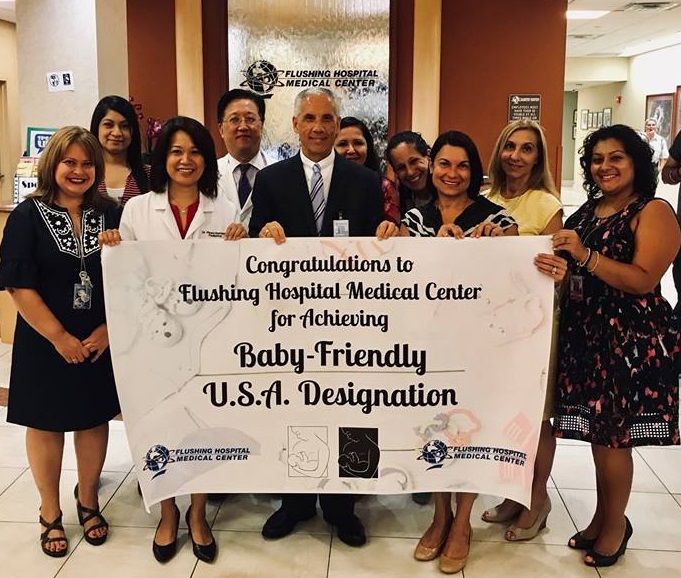
Flushing Hospital Medical Center Designated Baby-Friendly

Flushing Hospital Medical Center (FHMC) has received the prestigious international recognition as a Designated Baby-Friendly birth facility. Baby-Friendly USA, Inc is the U.S. authority for the implementation of the Baby-Friendly Hospital Initiative, a global program sponsored by the World Health Organization (WHO) and the United Nations Children’s Fund (UNICEF).

The initiative encourages and recognizes hospitals and birthing centers that offer an optimal level of care for breastfeeding mothers and their babies. Based on the Ten Steps to Successful Breastfeeding, this prestigious international award recognizes birth facilities that offer breastfeeding mothers the information, confidence, and skills needed to successfully initiate and continue breastfeeding their babies.

FHMC offers  the following classes free of charge at FHMC:
  • Childbirth education classes on Saturday monthly. Call
  • Infant feeding classes weekly on Tuesday at 10am Ob/Gyn Ambulatory Care Center on the 5th floor
  • Breastfeeding Support Group weekly, Wednesdays, 1pm 5 West conference room, by appointment
  • Free tours of the Perinatal area by calling
  • Women Infants and Children (WIC) office on the 5th floor

Robert Levine, Executive Vice President and Chief Operating Officer at FHMC, congratulated the entire OB/GYN team for their hard work.


All content of this newsletter is intended for general information purposes only and is not intended or implied to be a substitute for professional medical advice, diagnosis or treatment. Please consult a medical professional before adopting any of the suggestions on this page. You must never disregard professional medical advice or delay seeking medical treatment based upon any content of this newsletter. PROMPTLY CONSULT YOUR PHYSICIAN OR CALL 911 IF YOU BELIEVE YOU HAVE A MEDICAL EMERGENCY.

New Changes for MediSys MyChart

For many years, Flushing Hospital Medical Center has offered our patients the opportunity to better manage their healthcare and interact with their providers, through the MyChart patient portal.

Access to MyChart accounts has always required a patient’s physician to provide them with a special access code. Now, thanks to our partnership with Experian, our patients can create their very own MyChart account without needing an access code. For patients to create an account, they simply click the link to the MediSys MyChart website: https://mychart.medisys.org and click on the “sign up now” tab.

The new Experian verification process is much easier and will give patients quicker access to their chart, allowing them to take any number of actions, including:

  • Reviewing their medications, immunizations, allergies, and medical history
  • Reviewing test results online
  • Reviewing health education topics and discharge instructions
  • Requesting prescription refills online
  • Interacting with your provider via email
  • Requesting an appointment
  • Linking to family medical records

We hope that this new method of creating an account will encourage more patients to sign-up. By offering our patients easier access to their records, we feel they will become better educated and empowered to take a more active role in their health and the health of their family, which we feel will lead to a healthier patient population.

All content of this newsletter is intended for general information purposes only and is not intended or implied to be a substitute for professional medical advice, diagnosis or treatment. Please consult a medical professional before adopting any of the suggestions on this page. You must never disregard professional medical advice or delay seeking medical treatment based upon any content of this newsletter. PROMPTLY CONSULT YOUR PHYSICIAN OR CALL 911 IF YOU BELIEVE YOU HAVE A MEDICAL EMERGENCY.

Dr. Sherman Klein – Lyme Disease

With summer in full swing, we will be spending more time participating in activities outdoors in areas such as parks, forests and hiking trails.  While getting out and keeping physically fit is strongly encouraged it is important to keep in mind that being in these areas can put you at risk for Lyme disease.

Sherman Klein, MD, specializing in Internal Medicine at Flushing Hospital Medical Center’s Ambulatory Care Center offers the following information on Lyme disease, how it is spread, its symptoms, and treatment.

According to Dr. Klein, Lyme disease is the most common tick-born infection in New York City and in the United States.  On the east coast, Lyme disease is spread by the bite of a black-legged tick infected with the bacterium Borrelia burgdorferi.  Not all black-legged ticks carry this bacterium and, even if they are infected, they must be attached for at least 36 – 48 hours after a person is bitten to transmit the disease.

Black-legged ticks are rarely found in NYC, but if you have been traveling in more rural areas of New York such as Westchester and Long Island you are at greater risk of coming into contact with an infected tick.

The annual number of cases of Lyme disease reported continues to rise each year in non-rural communities.

Some of the early warning signs of Lyme disease are:

  • Muscle aches
  • Headache
  • Fatigue
  • Fever
  • Rash

These signs and symptoms may occur anywhere from three to 30 days after being bitten.  After an infected tick bite, a widening red area may appear at the infected site that is clear in the center, forming a bullseye appearance.

Dr. Klein suggests that the best way to avoid contracting Lyme disease is to avoid direct contact with ticks.  You can do this by avoiding wooded and brushy areas, and high grass.  If you are hiking, try to walk in the center of the trails and wear long pants and a long-sleeved shirt. If in a wooded area you should use a strong repellent (with Deet).  Dr. Klein cautions that when using any repellent, you should avoid applying the solution to your hands, eyes and mouth.

Some of the tips to find and remove ticks from your body and clothing are:

  • perform a check of your entire body viewing under your arms, behind and in your ears, inside your navel, behind your knees, along your legs, waist and hair. Also, check your pet.
  • Take a shower soon after returning indoors. If you wash within two hours of returning indoors, the ticks are more easily found and washed off your body.
  • Once you are indoors, take your clothing and place them in the wash using hot water and then put them in the dryer on “high” for at least 10 minutes; if the clothes were washed in cold water, place them in the dryer on “high” for at least 90 minutes

If Lyme disease is left untreated, it can spread to other parts of the body causing arthritis cardiac and nervous system problems.   Dr. Klein is one of the many qualified doctors specializing in Internal Medicine at Flushing Hospital Medical Center.  To schedule an appointment with him, or any of our other doctors, please call 718-670-5486.


All content of this newsletter is intended for general information purposes only and is not intended or implied to be a substitute for professional medical advice, diagnosis or treatment. Please consult a medical professional before adopting any of the suggestions on this page. You must never disregard professional medical advice or delay seeking medical treatment based upon any content of this newsletter. PROMPTLY CONSULT YOUR PHYSICIAN OR CALL 911 IF YOU BELIEVE YOU HAVE A MEDICAL EMERGENCY.

Sunglasses – Strength and Protection

At this time of year we spend more time outdoor and for that reason it is important to protect our eyes from the potentially harmful rays of the sun.

One of the ways we can do this is by wearing the right sunglasses. Don’t be fooled by the price tag when purchasing sunglasses. Just because sunglasses are expensive doesn’t always mean that they are the best at blocking the UV rays. Always check the label first.

For sunglasses to be completely effective they should:
• Block out as close to 100% of the UVA and UVB  rays as possible
• Block out 75 to 90 percent of the visible light
• Have gray lenses for proper color recognition

If we are exposed to too much UV rays, over time, it can cause cataracts and can also harm the cornea and the retina. Short term exposure to UV radiation can cause photokeratitis, an inflammation of the cornea. It is temporary in the short term but can have serious consequences long term.

It is also important that sunglasses fit properly. They shouldn’t be worn so close that they touch the eyelids yet not too far off that they let sun get in around them.

A good rule to follow is if you are wearing sunscreen you should also be wearing sunglasses.

All content of this newsletter is intended for general information purposes only and is not intended or implied to be a substitute for professional medical advice, diagnosis or treatment. Please consult a medical professional before adopting any of the suggestions on this page. You must never disregard professional medical advice or delay seeking medical treatment based upon any content of this newsletter. PROMPTLY CONSULT YOUR PHYSICIAN OR CALL 911 IF YOU BELIEVE YOU HAVE A MEDICAL EMERGENCY.

Lyme Disease Prevention Tips With Dr. Sherman Klein

With summer in full swing, we will be spending more time doing activities outdoors in areas such as parks, forests and hiking trails.  While getting out and keeping physically fit is strongly encouraged it is important to keep in mind that being in these areas can put you at risk for Lyme disease.

Dr. Sherman Klein, MD, specializing in Internal Medicine at Flushing Hospital Medical Center’s Ambulatory Care Center offers the following information on Lyme disease, how it is spread, its symptoms, and treatment.

Lyme disease is the most common tick-born infection in New York City and in the United States.  On the east coast, Lyme disease is spread by the bite of a black-legged tick infected with the bacterium Borrelia burgdorferi.  Not all black-legged ticks carry this bacterium and, even if they are infected, they must be attached for at least 36 – 48 hours after a person is bitten to transmit the disease.

Blacklegged ticks are rarely found in NYC, but if you have been traveling in more rural areas of New York such as Westchester and Long Island you are at greater risk of coming into contact with an infected tick.

The annual number of cases of Lyme disease reported continues to rise each year in non-rural communities.

Some of the early warning signs of Lyme disease are:

  • Muscle aches
  • Headache
  • Fatigue
  • Fever
  • Rash

These signs and symptoms may occur anywhere from three to 30 days after being bitten.  After an infected tick bite, a widening red area may appear at the infected site that is clear in the center, forming a bull’s eye appearance.

Dr. Klein suggests that the best way to avoid contracting Lyme disease is to avoid direct contact with ticks.  You can do this by avoiding wooded and brushy areas, and high grass.  If you are hiking, try to walk in the center of the trails and wear long pants and a long-sleeved shirt. If in a wooded area you should use a strong repellent.  Dr. Klein cautions that when using any repellent, you should avoid applying the solution to your hands, eyes and mouth.

Some of the tips to find and remove ticks from your body and clothing are:

  • Do a check of your entire body viewing under your arms, behind and in your ears, inside your navel, behind your knees, along your legs, waist and hair. Also, check your pet.
  • Take a shower soon after returning indoors. If you wash within two hours of returning indoors, the ticks are more easily found and washed off your body.
  • Once you are indoors, take your clothing and place them in the wash using hot water and then put them in the dryer on “high” for at least 10 minutes; if the clothes were washed in cold water, place them in the dryer on “high” for at least 90 minutes

If Lyme disease is left untreated, it can spread to other parts of the body causing arthritis cardiac and nervous system problems.   Dr. Sherman Klein is one of the many qualified doctors specializing in Internal Medicine at Flushing Hospital Medical Center.  To schedule an appointment with him, or any of our other doctors, please call 718-670-5486

All content of this newsletter is intended for general information purposes only and is not intended or implied to be a substitute for professional medical advice, diagnosis or treatment. Please consult a medical professional before adopting any of the suggestions on this page. You must never disregard professional medical advice or delay seeking medical treatment based upon any content of this newsletter. PROMPTLY CONSULT YOUR PHYSICIAN OR CALL 911 IF YOU BELIEVE YOU HAVE A MEDICAL EMERGENCY.

Drinking Alcohol in Hot Weather

Drinking alcoholic beverages in hot weather can have serious consequences.  During extreme heat, we sweat more and drinking alcohol can cause us to lose fluids because of an increase in urination. This combination can lead to dehydration.
Dehydration in hot weather can cause:
• Dizziness
• Muscle cramps
• Disorientation
• Fatigue
• Impaired judgement
• Heat stroke
The body’s temperature is regulated by the hypothalamus gland. Alcohol will cause a slowing down of the  hypothalamus, so if the body is already hot because of the heat, the effects of alcohol will make the body think it is even hotter.
If you choose to drink alcoholic beverages in the hot weather, drink them slowly, and have a glass of water at regular intervals to keep yourself hydrated. Be mindful of the fact that your judgement may be impaired so don’t lay out in the sun for too long, and definitely don’t  swim beyond your capabilities.
Be smart, drinking alcohol at any time of year can be dangerous if it is done in excess. Watch what you are doing and have a safe summer.

All content of this newsletter is intended for general information purposes only and is not intended or implied to be a substitute for professional medical advice, diagnosis or treatment. Please consult a medical professional before adopting any of the suggestions on this page. You must never disregard professional medical advice or delay seeking medical treatment based upon any content of this newsletter. PROMPTLY CONSULT YOUR PHYSICIAN OR CALL 911 IF YOU BELIEVE YOU HAVE A MEDICAL EMERGENCY.

History of Contact Lenses

Contact lenses are so commonly worn today that people don’t give them a second thought. Did you know that the concept for contact lenses goes all the way back to Leonardo DaVinci who described them back in 1508. Many scientists experimented with different materials over the next few centuries with only a little success. It was in the late 1800’s that German scientists devised a  prototype of a contact lens made from a thin piece of glass that covered the entire eye. In the early 1900’s it became possible to make a mold of the entire eye and this helped to make lenses that fit better.  By the 1950’s plastics were being developed that could be made thinner and with a better fit for the eye and they were replacing glass as the material of choice for contact lenses.  In 1960 the company Bausch and Lomb developed a technique to cast hydrogel, a plastic material that could be molded and shaped when wet, which allowed for the production of lenses that were able to be mass produced and of extremely high quality. Today lenses are much more comfortable than the lenses made 20 years ago. They can be worn for long periods of time and they allow the eye to breathe which earlier versions couldn’t do.
If you would like to make an appointment with our ophthalmology department please call 718-670-5486.

All content of this newsletter is intended for general information purposes only and is not intended or implied to be a substitute for professional medical advice, diagnosis or treatment. Please consult a medical professional before adopting any of the suggestions on this page. You must never disregard professional medical advice or delay seeking medical treatment based upon any content of this newsletter. PROMPTLY CONSULT YOUR PHYSICIAN OR CALL 911 IF YOU BELIEVE YOU HAVE A MEDICAL EMERGENCY.

Flushing Hospital Receives Patient Safety Award and Ranks in Top 10% in Nation for Patient Safety

If you are sick and need to go to the hospital, it is important to know that if admitted, your hospital is dedicated to safety, and has a proven track record of preventing further illness and injury to its patients.

Healthgrades, a trusted provider of information to millions of health care consumers across the United States, recently recognized the best-performing hospitals in the country and Flushing Hospital Medical Center received the Patient Safety Excellence Award, an accolade that recognizes hospitals that lead in the prevention of patient safety events.

This prestigious honor highlights the hospital’s performance in safeguarding patients from serious, potentially preventable complications during their hospital stay.   Flushing Hospital, part of the MediSys Health Network ranked in the top 10% in the nation for patient safety.

To determine which hospitals receive the Patient Safety Excellence Award, Healthgrades reviews the results of 14 key patient safety indicators submitted by hospitals to the Centers for Medicare and Medicaid Services (CMS). Some of the safety measures surveyed include pressure ulcers, catheter-related bloodstream infections, and postoperative sepsis rates.

Flushing is one of two hospitals in Queens and one of only four in New York City to receive this honor. The hospital attributes their vastly improved safety rates to robust quality improvement policies and programs that were initiated over a decade ago and that are still being followed and improved upon every day.

According to MediSys Health Network President, Bruce J. Flanz, “Patient Safety is one of the top priorities at Flushing Hospital. We are proud to be in a position to provide our patients with a safe and trusted environment to receive high-quality care. I would like to thank the many members of our staff who are committed to this effort.”

All content of this newsletter is intended for general information purposes only and is not intended or implied to be a substitute for professional medical advice, diagnosis or treatment. Please consult a medical professional before adopting any of the suggestions on this page. You must never disregard professional medical advice or delay seeking medical treatment based upon any content of this newsletter. PROMPTLY CONSULT YOUR PHYSICIAN OR CALL 911 IF YOU BELIEVE YOU HAVE A MEDICAL EMERGENCY.